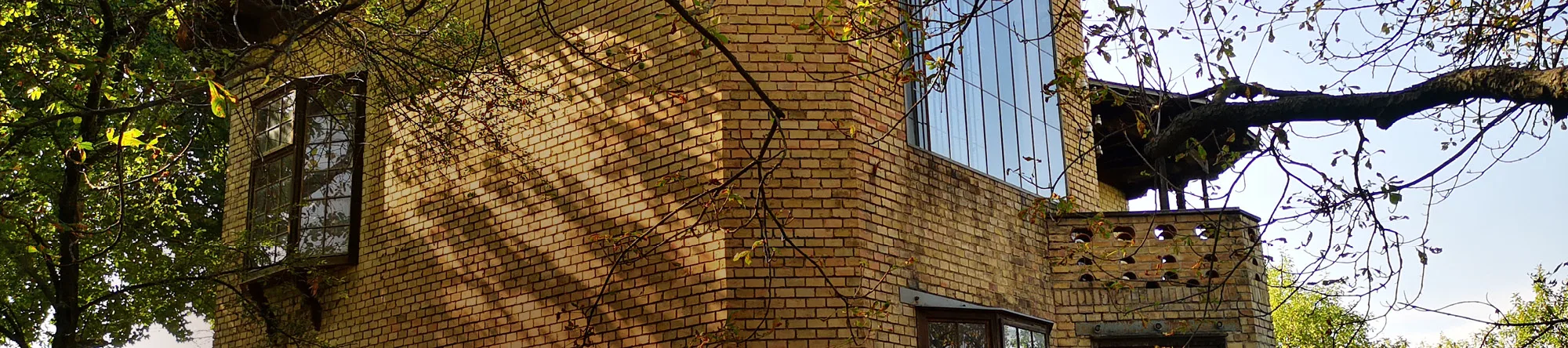
The Gödöllő artist colony was one of the collaborative creative workshops that emerged in Western artistic circles around the turn of the century. Its activity began in 1901 when the painter Aladár Körösfői-Kriesch moved from Budapest. He, along with his sister, Laura Kriesch, and her husband, Sándor Nagy, later joined by friends (sculptors, painters, furniture designers), connected with the Arts and Crafts movement of the time. This movement sought the revival of artisanal craftsmanship, drawing inspiration partly from British figures like John Ruskin and William Morris. Körösfői-Kriesch gave a lecture series on their work in 1904 and translated many of their writings. At the same time, the colony incorporated techniques and decorative arts from the still-vibrant folk traditions of Central, Eastern, and Northern Europe.
This dual inspiration led to the establishment of a weaving school and workshop, where traditional domestic techniques were combined with Western weaving traditions, such as tapestry (gobelin), supported by the involvement of Leo Belmonte, who was invited to settle there. Their first and only major exhibition was held in 1909 at the National Salon. The colony’s members were also commissioned to “decorate” new public buildings, producing stained glass windows, murals, furniture, and wall and floor tapestries for venues ranging from the Budapest Music Academy to the Palace of Culture in Marosvásárhely (Târgu Mureș).
The weaving workshop became the training centre of the Royal Hungarian School of Applied Arts, where Jenő Remsey received a scholarship in 1909. Körösfői-Kriesch led the decorative painting department of the school. The young Remsey, with his socially committed and expressively concise style that rejected traditional forms, made a bold impact on the Gödöllő circle, which was otherwise dedicated to Beauty, Art, and Symbolism. Following the dissolution of the artist colony in 1921 or 1922, Remsey founded the Remsey Carpet and Tapestry Workshop. During this period, both his painting and literary work developed a unique symbolism, reflecting his dedication to light and spirituality. Among his literary works, The Island of the Blessed, (A boldogok szigete) an “allegorical dream poem,” was published by the Spiritual Artists’ Association, which he founded in 1924.
Until his death in Gödöllő in 1980, he remained a custodian of the memory and spirit of the Gödöllő artist colony.
Katalin Keserü
Art historian
Remsey Carpet and Tapestry Workshop
Vilma Frey arrived in Gödöllő in 1904 to join the weaving school, which functioned as the applied arts workshop of the Gödöllő Artist Colony. She came from Bácska in response to a nationwide recruitment campaign. Aladár Körösfői-Kriesch, one of the founders and intellectual leaders of the Gödöllő Artist Colony, took on the task of relocating a weaving workshop—already successful in world exhibitions—from Nagybecskerek to Gödöllő. This was necessary because in Torontál County, they could not find a suitable successor to lead the workshop or financial support for its operation. Sarolta Kovalszky, a distinguished weaving master, and Margit Guilleaumme, a weaver, assisted in training the girls and women who came from the surrounding area and other parts of the country to Gödöllő. The Frey sisters arrived at this time and were involved in the work from the early days of the workshop. Through the weaving school, they became connected with the artists working there, and they are now considered members of the Gödöllő Artist Colony.
These experiences helped Vilma Frey and her husband, Jenő Remsey, establish their own weaving workshop after the death of Aladár Körösfői-Kriesch in 1920, with the support of an unnamed friend. Jenő Remsey and Vilma Frey designed the tapestries together. They taught weaving to middle-class and artisan girls from Gödöllő, who, after acquiring sufficient skills in the workshop, could create textiles from their own homes. The workshop’s products were featured in the offerings of OUR SHOP, a company that facilitated the sale of textile workshop products, primarily abroad.
Another weaving workshop linked to the Remsey family was founded in 1939, associated with the name of Ágnes Remsey. The young artist established the workshop with the help of a self-employment loan available at the time. Textiles made in the *Palotás Workshop Gödöllő* can still be found today. When designing tapestries, the workshop used illustrations from Dezső Malonyay’s volumes *The Art of the Hungarian People*. Folk motifs and scenes from everyday life can be found on the tapestries. According to the workshop’s promotional leaflet, the products were sold in Budapest at the “Palotás” Carpet Salon on Váci Street.
In 1939, the Remsey family jointly ran the workshop, with Iván, Gábor, and András Remsey assisting with the reworking of workshop drawings—scaling them up or down. At that time, 20–25 looms were in operation in the workshop, and in addition to folk motifs, designs from old Eastern carpets were also used for their knotted tapestries.
Ágnes Remsey’s workshop operated until 1947.
Cecília Nagy Őriné
Art Historian